
Increase Payment Card Use Online Everyday
Keep your cards front-and-center all year with popular online buying events happening monthly, and more events being created regularly by retailers and vendors.
Market Signal — April 2026
60%
of Gen Z favors debit cards — even under economic pressure.
A whole generation of cardholders is choosing debit first and living inside mobile wallets. Keeping your debit card front-and-center in that wallet is no longer a bonus — it's the whole game.
Use Cases
Start at activation. Keep capturing for the life of the card.
CardLinks™ are personalized URLs that put a cardholder’s card on file at the merchants they choose — drop them into any cardholder touchpoint. And there’s always a next one.
Phase 1 · Activation — first 14–30 days
Land the card
The Top of Wallet® Moment: when a cardholder picks the card that becomes their default — and card-on-file habits form with whichever card they activate first.
Win Top of Wallet at activation
Capture the default-card slot in the window when on-file habits are still forming.
Where: Card carrier · Production & re-issuance · Banking app · CSR hand-off
Onboard new cardholders
Place cards for first-time accounts that have no on-file relationships yet.
Where: Card carrier · Production & re-issuance · Banking app
Recover revenue lost to reissuance
Restore the placements a new PAN severs — across ~700M US reissue events a year.
Where: Production & re-issuance
Phase 2 · For the life of the card
Keep it on file
Recurring touchpoints keep the card placed and win back whatever lapses.
Win back & retain on a recurring cadence
Recover lapsed placements and sustain engagement long after activation.
Where: Statements · Marketing campaigns
Run targeted seasonal & cohort campaigns
Calendar-driven and ad hoc plays aimed at the cohorts you choose.
Where: Marketing campaigns
Turn service moments into placements
Activation calls, branch visits, and fraud-resolution hand-offs each become a placement.
Where: CSR hand-off
Phase 3 · Co-brand & partner
Expand
Partner channels carry the link where the cardholder already engages.
Activate co-brand & partner channels
The partner's own app and loyalty emails place the card at first engagement after receipt.
Where: Co-brand channels
However you deploy them, the outcomes are the same.
CardLinks · Always-on
CardLinks Daily.New
Always-on, production-triggered card-on-file. Set it up once — then every card you produce, new or reissued, automatically triggers a personalized CardLink™ that reaches the cardholder at their optimal Top of Wallet® Moment. No campaign to launch. No timing to guess.
- No marketer lift — it runs continuously, with no campaign to build or launch.
- Perfectly timed — delivery arrives at each cardholder’s Top of Wallet® Moment by construction, because their card-production date is the trigger.
- Covers reissues, not just new accounts — the largest, most-neglected source of card-issuance volume.
How it works
Trigger on every card produced
We ingest your card-production feed — new accounts and reissues alike — on your natural cadence.
Generate personalized CardLinks
For each cardholder, Strivve builds a tailored merchant set and the ready-to-send message.
Deliver at the Top of Wallet Moment
The batch hands off to your existing marketing platform, timed about 21–30 days after production.
Measure placements & lift
Placement events close the loop through CardSavr®, reporting results against each production cohort.
Personalization, your way
Signal-driven
A per-cardholder merchant set built from prior transaction signal.
Issuer-curated
A single brand-curated merchant set your marketing team picks and refreshes.
Strivve-recommended
The top-converting merchant set across your portfolio, issuer-approved — the fastest to deploy.
Daily mirrors CardLinks Emboss™’s production trigger — Emboss makes the physical card, Daily makes the digital follow-up on the same trigger.
CardLinks · Marketer-launched
CardLinks Campaigns.
Marketer-launched card-on-file campaigns tied to the moments you choose — Black Friday, tax season, back-to-school — no digital banking integration required. Build an audience, launch, and measure using existing tools.

Build Your Campaigns
Target under-represented transaction volumes, by payment site types, or by new cardholders activations, or by build spend, curate incentives with instant reward options and types.
Introducing
CardLinks Emboss.
Drive top-of-wallet status starting at card production—no digital banking integration required. Use CardLinks Emboss with card carriers and other activation materials, letting cardholders engage instantly through personally unique QR codes.
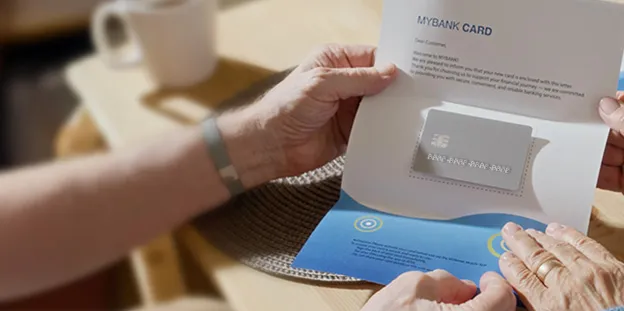
Create CardLinks From New Card Emboss Records
Easily augment production emboss process to generate CardLinks for each new card record.
The ROI Story
$1 per site. 12× or more in Year 1. Compounds for the life of the card.
Card-on-file placement is a one-time cost. Interchange income is a recurring stream. Once a cardholder’s card lives at a merchant, every transaction at that merchant feeds your card-program revenue — for the life of the card.
One cardholder, five common merchant sites
Conservative 1.8% blended interchange rate — below credit-only average; well below premium credit and co-brand retail rates.
| Site placed | Avg annual $ | Strivve fee | Y1 interchange | Y2 | Y3 | Y4 | 4-yr total |
|---|---|---|---|---|---|---|---|
| Amazon Prime | $1,500 | $1 | $27 | $27 | $27 | $27 | $108 |
| Home Depot | $700 | $1 | $12 | $12 | $12 | $12 | $48 |
| CVS Pharmacy | $1,044 | $1 | $19 | $19 | $19 | $19 | $76 |
| Expedia | $2,450 | $1 | $44 | $44 | $44 | $44 | $176 |
| AT&T (recurring bill) | $2,700 | $1 | $49 | $49 | $49 | $49 | $196 |
| Total — one cardholder | $5 | $151 | $151 | $151 | $151 | $604 |
The one-card story
$5 of Strivve fees produce $151 in Year-1 interchange income. Over four years — the typical card lifecycle — the same $5 returns $604. That is 121× lifetime ROI and 30× in Year 1 alone. Even the lowest-AOV site (Home Depot, $700/year) returns 12× in Y1; the highest (AT&T autopay, $2,700/year) returns 49×.
Why this compounds — and Account Updater doesn’t
Account Updater refreshes card credentials at network-opt-in merchants when a card is reissued. CardLinks place the card at every merchant the cardholder selects, in every marketed moment. Once placed, the card stays placed.
Issuers running CardLinks alongside Account Updater see 3–5× the placement volume because the merchant populations don’t fully overlap. CardLinks and Account Updater are complementary, not competitive.
The formula
Annual interchange = Cardholders × Opt-in % × Sites per cardholder × Annual $ per site × Interchange %
Size your portfolio →Strivve & MSUFCU Case Study, 2025. Interchange rates and Average Order Value (AOV) examples are conservative public estimates; actual figures vary by issuer, program, and card type.
Explore Card-on-File Solutions
Single Campaign - Per Site Updated
As needed campaign, no long term commitment necessary.
USD
per site updated
Terms
- $10,000 minimum total fees
- Less than 200,000 unique cardholders
- Custom branding
- Strivve flow analytics provided
Single Campaign - Unique Targets
As needed campaign, no long term commitment.
USD
per site updated
Terms
- Target over 200,000 unique cardholders
- No minimum fees
- Custom branding
- Strivve flow analytics provided
Annual Campaign Bundles
Committed campaign capacity with discounts.
USD
per site updated
Terms
- Flexible pricing models
- Unlimited target options available
- Best value per placed card/site
- Platform pricing not available
Annual Cardlink Emboss Pricing
Annual CardLinks program pricing for personalized COF.
Terms
- Varies by cards produced per month, or flat annual committed pricing available upon request
- Custom branding
- Strivve flow analytics
Grow Card Payment Volumes Today - Pay Only For Success
Marketers: Campaign-specific pricing and Pilot Pricing Available Digital Solutions: Only pay one-time per-site, all future payment income is 100% yours!
Related Resources
Card-On-File For Credit Unions
Helps credit unions place their debit and credit cards as the default payment method across online merchants.
Learn More →
Card-On-File For Banks
Helps banks place their debit and credit cards as the default payment method across the online merchants where their cardholders already shop.
Learn More →
The Future of Card-On-File
The card that's stored on a merchant's site is the card that gets used. As commerce moves online we keep you relevant.
Learn More →
Strivve Platform Security
Validated as a PCI DSS Level 1 Service Provider, with dual-key encryption and zero-knowledge authentication on every card placement.
Learn More →
FAQs
CardLinks are nothing more than a secure, personal HTTPS URL, which has the cardholders payment card data and billing address data safely stored or referenced behind it. Strivve’s Top of Wallet® CardSavr™ platform is the foundation for CardLinks capabilities. When the URL is loaded by a browser, webview, or launched in a mobile application webview, a personalized and branded card-on-file placement flow using Strivve C/X user interface components is launched for the cardholder to make use of and complete the card placement operation themselves from their device.